Recording Vocals
Recording vocals is somewhat simpler to start than recording other instruments because there is usually a simpler and more standard mic technique. Almost always, vocalists are recorded using one mic at close range. The trick here is usually to match the microphone to the singer and the production. Different microphones have different sounds that compliment different voices. Male voices are sometimes enhanced by a dynamic mic like a Shure SM7B or an Electro-Voice RE20. But many males are recorded using a condenser like a Neumann U87 or a Rode NT1A. Female vocals may sound better using an AGK C12 or C414. But there is no reason why a Shure SM58 dynamic mic might not sound better for a paticular female voice. With vocalisits, just keep testing and comparing until you find the best match for the paticular voice you are recording. And don't forget it also matters how that fits into the production you are creating.
You could try a mic shootout. Line up several different mics and have the singer sing one take in each mic. Then sit back and listen and compare and pick your favorite. The most expensive mic doesn't always win. Sometimes the $100 mic sounds better.
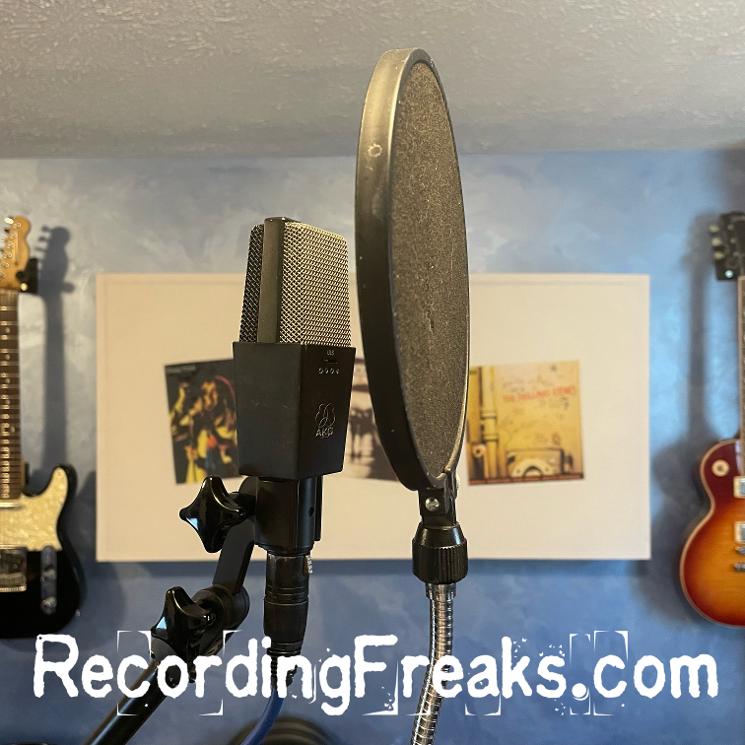
You should always use a pop filter (or wind screen) to cut down on the wind from the vocalist hitting the mic diaphragm. Sometimes, you might need two pop filters. Although pop filters can start to have an effect on the sound or create a slight muffling effect. There are metal and nylon pop filters that can be held by a goose neck between the vocalist and the mic. You can also use a foam wind screen to cover the mic.
Certain sounds tend to require more air that can hit the mic. These sounds are called plosives. Usually letters like "P", "B", "T", or "F" inside words require the vocalist to push more air. A vocalist can diminish this problem by learning proper mic technique. The vocalist can learn to turn their head slightly during these sounds, which will direct the air away from the mic diaphragm. It also helps if the vocalist leans closer to the mic during the quieter sung parts and steps away from the mic during the louder sung parts of the song. This will somewhat level out the volume differences and possibly save on using heavier compression later.
A good starting spot would be to place the vocalist's mouth about 8" away from the microphone. The wind screen should be 1-3" away from the microphone. Cardioid microphones will exhibit a proximity effect when the vocalist is close and have an enhanced bass response. So you can get real close to get more bass when using a cardioid mic, or get further away for less bass. The closer the vocalist is to the mic, the less room sound you will get. The further away the vocalist is from the mic, the more room sound you will get. If you are having a problem with plosives, the mic can be positioned slightly above the vocalist's mouth pointing down at the mouth, or slightly below the vocalist's mouth pointing up at the mouth. This change in positioning will effect your sound and the vocalist's tone somewhat. For example, moving the mic higher may create a more nasal sound.
As with any recording, make certain that you preamp and recording levels are appropriate. For most modern digital equipment, peaks in the -20 to -10dB range is a good place to be. With older analog equipment, it was often good to drive the levels above 0dB. If you record too loud, you'll get distortion. If you record too quiet, you may hear the noise floor of your equiment when you turn up the track.
It is important that the vocalist is made comfortable in the accepting attitudes of those around them and in the environment. The vocalist usually needs to feel confident to give a good performance. Sometimes this means building up their confidence in how we talk to them. It may also mean that having too many people, or the wrong perople, in the studio when recording vocals could inhibit them and lead to a poor performance. If necessary, clear out everyone, except for the vocalist and the engineer.
There is information about mixing vocals and using EQ, compression, delay, reverb, etc. on the Mixing page.
Summary:
1. Try different mics for the singer.
2. Use a pop filter.
3. Beware of plosives.
4. Start with the vocalist about 8" away from the mic.
5. It helps if the vocalist can use good mic technique.
6. Set your peak recording level to about -20 to -10dB.