Recording Piano
The acoustic piano is one of the most full range instruments you can record. It has complex overtones that make up it's character. Like recording all other instruments, start by getting the sound source the best it can be. If you start with a bad sounding piano, there may be no fixing it. So use the best piano you can find, even if you have to borrow one or change locations.
Always make sure the piano you are about to record has had a recent tuning. I like to have the piano tuned within a couple of days before recording, when possible.
The brand of the piano makes a great difference in the quality of the sound and the type of sound (bright, dark, etc.) Here is a webpage that discusses the various brands out there. In general, the larger a piano is, the better it will sound. Example: A 7'6" piano usually sound better than a 5'3" piano of the same brand.
Grand Pianos have a lid that opens that allows more sound to come out. You want to have this lid open to record them. The only time you would record a grand piano with the lid closed, would be if you were recording it in a room with other instruments playing at the same time, and needed the separation. While you can record a piano with one microphone, you should use two or more when possible. It is hard to get an even representation of all the notes on a piano with only one mic. If you are using only one mic, either back the mic away from the piano to get even volume from all the notes, or aim the mic at the strings of the piano that you want to be the loudest notes in the final mix.
Moving the mics further away will add more room reverb. Moving the mics closer will sound dryer with less room reverb. The busier your mix is, the closer you may want the mics to be. Also, song tempo can have an impact with mic'ing distance. A fast tempo songs may sound better with less room reverb. So closer mics might be in order. A slow tempo song may sound better with more room reverb, so mic'ing further away could be in order. If the piano is featured prominently in a song, moving the mics further away could work better. Although this is certainly not a rule that always works, here are the elements that might help make a decision about mic distance:
Mics closer: Crowded, busy mix; Fast tempo; Piano ia a small role player in the mix.
Mics further away: Open mix; Slow tempo; Piano is featured in the mix.
Another option would be to use more artificial reverb later and less room sound when recording.
When using two mics, a coincident pair is a simple option that will almost always yield usable results. You place two mics together, so that the capsules are nearly touching, and angle the mics at 90 degrees to each other. One mic should be above the other. You don't have to worry about phase issues with this technique, since the capsules receive the sound from all notes at the same time. The mics should be pointed at the hammers and placed near the center of the piano or the mid-point between where the pianist will spend most of their time playing. While coincident pair makes a trouble free recording with no phase issues, sometimes your sound may be a little plain and less complex than other mic techniques.
Another two mic option is the spaced pair. The spaced pair uses two mics placed apart pointing at the strings. Usually one pointing at the bass strings and one at the treble strings. These can be placed at a closer distance for less room sound or further away for more room sound. When close micing, smaller movements on mic placement have a great effect on the sound. You can experiment with this, but I prefer looking at which strings the pianist spends most of their time playing on the particular song, and placing one mic pointing at the hammers where the right hand plays the most notes, and placing the other mic pointing at the hammers where the left hand plays the most notes. Often with spaced pairs and close micing, some notes between the two mics will not sound as focused and rich as the notes directly in front of the mics. This is the negative part of close micing a piano with a spaced pair. The positive is the rich sound you get on the other notes. The further away you get from the piano with the mics, the less this is an issue.
A third or fourth mic can be added to the pairs above. This could be a room mic placed elsewhere in the room, usually further away. It could be a third mic placed between the spaced pair. You can also place mics on the opposite side of the soundboard (under a grand piano) for a different sound that is usually darker. Experimentation is the key here to find other sounds in the room that will work well for the song you are recording and add the character you are looking for.
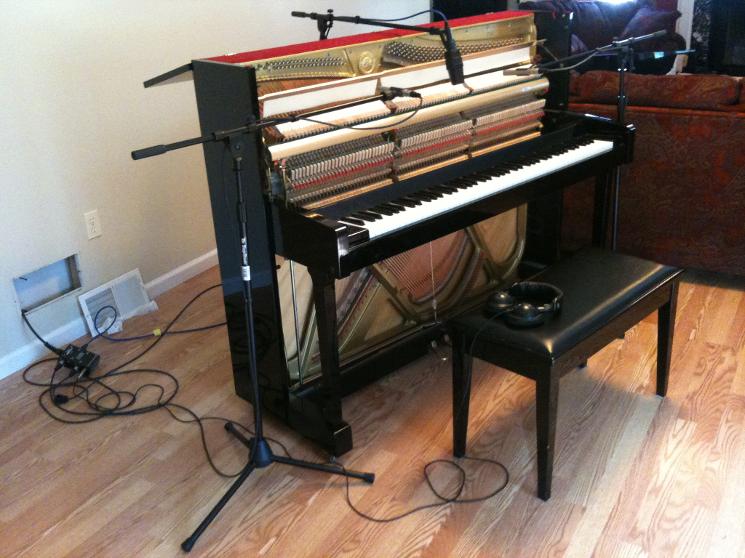
Upright Pianos usually have a smaller sound board than grand pianos, and therefore may not sound as full. But some large uprights are actually bigger than some smaller grand pianos. When recording uprights, at the very least open the top lid to let the sound out. I like to take all the covers (top, front, and bottom) off an upright piano before I record it. It sould more clear and open this way. You can follow the tips above for mic'ing an upright piano, usually aiming your mics where the hammers hit the strings. The soundboard can be mic'ed from the front or back of the upright, but the back position will record less pedal noise.
Summary
1. Tune the piano before recording.
2. Bigger is better.
3. Use the best piano you can find.
4. Open the lid on a grand, remove all covers from an upright.
5. Try different mics using coincident or spaced pairs.
6. Find the right mic distance for the song.
7. Add a third or fourth mic when you can.